Family: Brassicaceae
Mongolian name:
English name: Hairy rock-cress
Collection Number: 17
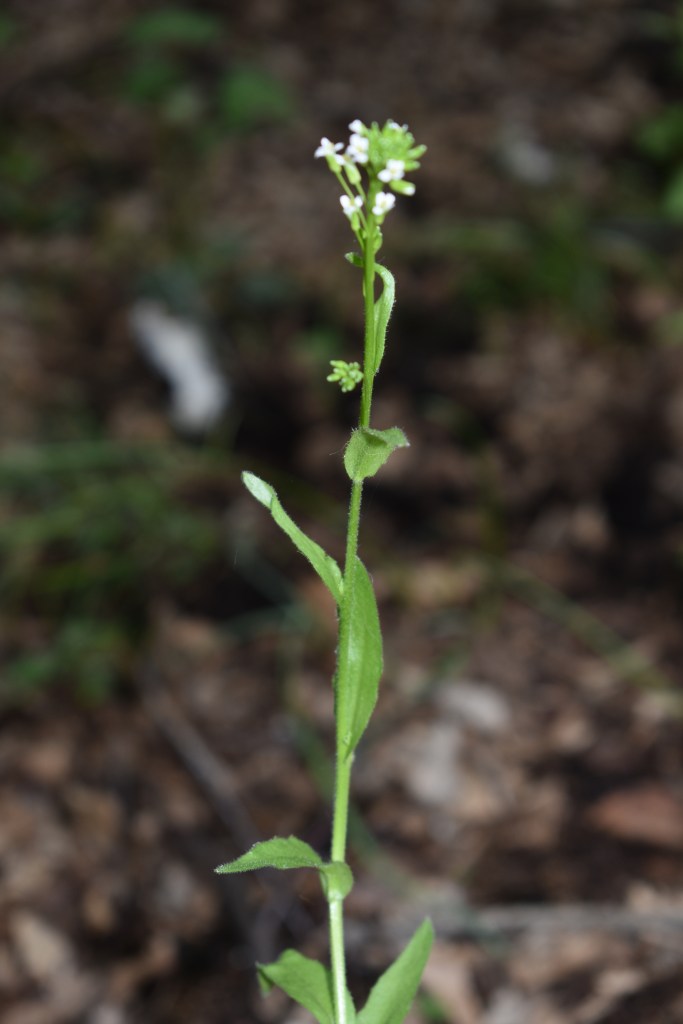

Arabis hirsute is a small perennial herb (10-20 cm tall) noted for drought-tolerance and ability to colonize soils with low nutrients, particularly rocky soils. There is some disagreement on taxonomic classification, as Karl and Koch (2014) argue that the A. hirsuta aggregate is best limited to European (not East Asian or North American) based on phylogenetic, biogeographic, morphological and climate data. There are claims in non-specific folk medicine that it has been used to treat respiratory, digestive, and skin issues, and may be consumed as greens (leaves) or seasoning (seeds).
Citations
“Arabis hirsuta.” 2024. Plants of the World Online. Royal Botanic Gardens Kew. Accessed July https://powo.science.kew.org/taxon/urn:lsid:ipni.org:names:278269-1.
“Arabis sagittata.” 2024. Plants of the World Online. Royal Botanic Gardens Kew. Accessed July 9. https://powo.science.kew.org/taxon/urn:lsid:ipni.org:names:278591-1.
“Arabis sagittata.” 2025. Vegetation Science Group and European Vegetation Survey. Accessed July. https://floraveg.eu/en/taxon/overview/Arabis%20sagittata.
Hairy Rock Cress | A Guide to Plant Identification & Care. . http://www.wildflowerweb.co.uk/plant/1542/hairy-rock-cress, accessed April 16, 2025.
Karl, Robert, and Marcus A. Koch. 2014. Phylogenetic Signatures of Adaptation: The Arabis Hirsuta Species Aggregate (Brassicaceae) Revisited. Perspectives in Plant Ecology, Evolution and Systematics 16(5):247–264. https://doi.org/10.1016/j.ppees.2014.06.001.

